
On this page
In short. These screens show what the engine found, what it proposes, what a person decided and what the decision produced against your own results. The engine learns only from outcomes a person confirmed, and it never runs an action by itself.
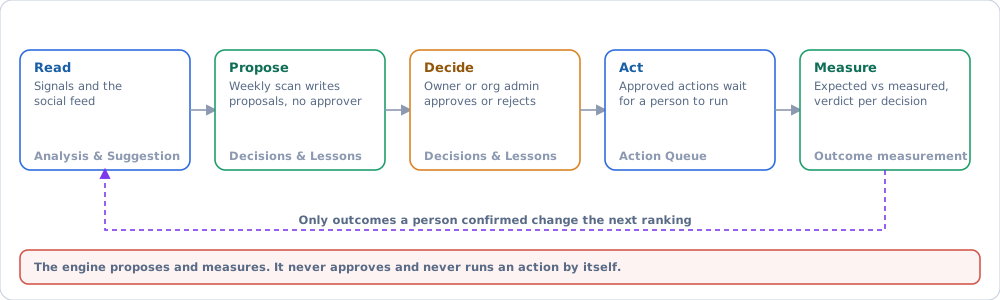
How it works#
The screens are the nine surfaces of the Marketing Systems OS package. A platform administrator turns the package on for an organization; it needs the social intelligence package and is off until then. With the package off, every screen leaves the menu and a typed address is refused.
When it is on, six screens sit under Hệ vận hành Marketing (Marketing Systems OS) and three under Trợ lý AI (AI Assistant). Owners and org admins see them first and can grant other roles.
| Screen | What it answers | Who acts |
|---|---|---|
| Analysis & Suggestion (Phân tích & đề xuất) | Is the loop running, and what does the diagnosis say? | Read-only |
| Social signals (Tín hiệu mạng xã hội) | Which lever had the conversation this week, and which to try next? | Read-only |
| Decisions & Lessons (Quyết định & Bài học) | Inbox, timeline, calibration, what happened last time | Owners and org admins decide; others read |
| Outcome measurement (Đo lường kết quả) | Expected, measured, difference, verdict, system health | Read-only |
| Industry playbook library (Thư viện playbook ngành) | Each rule, its version and track record | Read-only here |
| Operating settings (Cấu hình vận hành) | Verdict tolerance, scan severity, conversion metric | Holders of the organization-settings capability |
| Action Queue (Hàng đợi hành động) | Actions waiting, experiments running, monthly approval rate | AI management and action management |
| Weekly action memo (Ghi chú hành động tuần) | A week of findings graded info, watch or critical | Decision management publishes |
| Automations (Tự động hoá) | Which operational chains run, on which trigger | AI management and automation holders |
The first screen opens with a loop band: signals read, signals fired or withheld with the reason, runs proposed or abstained, and the proposals nobody has answered yet, with the age of the oldest. An organization with marketplace orders also sees the diagnostic chain below it, and each culprit links to its proposal in the Action Queue. An organization measured on leads sees a chain built on its own conversion.
Automations chain operational actions on a canvas. A chain starts from one of these triggers: manual, schedule, an alert, after an upload, after a sync, a customer entering or leaving a segment, a service case opened, an SLA breach, a refund, a negative review. Its steps land in the Action Queue as proposals.
How it learns#
| Mechanism | Learns from | Changes |
|---|---|---|
| Playbook track record | Outcomes an owner or org admin confirmed | Rank of playbooks at the proposal step |
| Off-take statistics | Your own weekly history, tested forward in time | Which lever is proposed and its forecast impact |
| Signal feedback weight | People dismissing a signal | Lowers its rank in the brief (Signals and the morning brief) |
The engine's verdict (hit, partial, miss) enters the track record only after an owner or org admin ratifies or overrides it. The worker writes proposals and measurements, never an approval.
Why it claims no causal effect#
Each decision records the candidate set, the choice, its probability and a measurement window declared before any result existed. Readouts are before-and-after comparisons on first-party data and carry a "confounded" label (Measurement and honest numbers). Below its evidence floor a readout says so instead of printing a verdict.
Where it stops#
Where each part stands is on Project status; the mechanism is on The decision engine.
- The Monday 06:30 proposal scan runs only where the package is on and a conversion metric is declared.
- A proposal stays in the learning state until the conversion feed returns data for its window.
- The engine reads your own first-party data and the social listening feed as a signal. It never treats a third-party estimate as an outcome and never writes outside the platform.
- Rule editing is not on these screens; see Marketing playbooks.