
On this page
In short. Content Intelligence turns a discussion corpus about a brand into a vocabulary the organization owns, then into delivery decks built on that vocabulary. Every edit applies to the open dataset only, and the dataset is chosen in the page address, so a reload or a shared link keeps it.
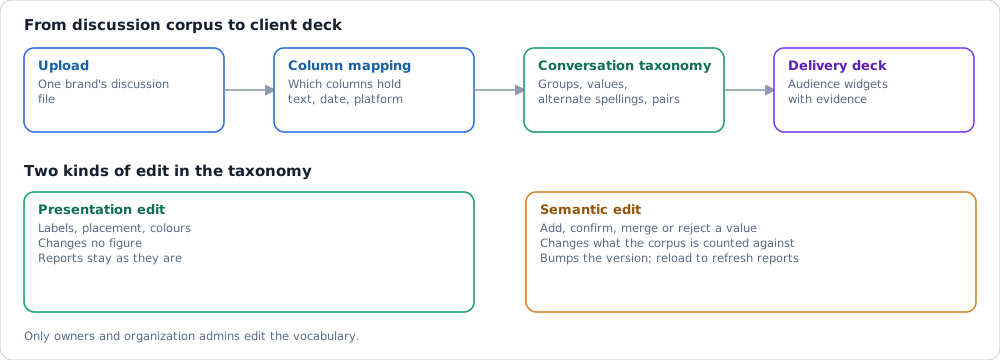
How it works#
A corpus arrives by file upload. Column mapping and taxonomy come before a deck: registering a dataset is the last onboarding step. A standard file runs through that flow in the interface; a two-file join, unusual cell formats or a large volume needs a platform administrator.
The corpus is the organization's own signed-off deliverable. It is first-party data, counted inside the metric reconciliation gate, and carries no estimate badge. It never mixes with the third-party plane in Market and social intelligence.
| Screen | Route | Answers |
|---|---|---|
| Conversation taxonomy | / |
What is the corpus's vocabulary, and what is still unclassified? |
| Layout studio | / |
What should a new delivery deck look like? |
| Delivery decks | under Dashboards | What does the audience say, with evidence? |
/content-intelligence on its own forwards to the taxonomy studio.
The taxonomy studio
A dataset bar at the top picks the corpus (?dataset= in the address). Only owners and organization admins edit. Cloning copies a vocabulary to another dataset.
| Concept | What it does | Note |
|---|---|---|
| Groups and values | Content dimensions and their labels | Each carries a data kind, a role, a minimum base, a dashboard placement |
| Pending, then Confirm | A new value starts unclassified | The pending count always shows, even at zero |
| Alternate spellings | Maps a raw-text variant to a value | Suggested by near-match; a person always confirms |
| Cross pairs | Declares "group A cut by group B" for a matrix chart | Never inferred |
| AI suggestions | Proposes edits a person applies one at a time | No accept-all |
| Label-quality receipt | Records an independent re-labelling agreement level | A deck with a client link waits for it after a new load |
There are two kinds of edit. A presentation edit changes labels, placement or colours and changes no figure. A semantic edit (add, confirm, merge or reject a value, change a group) changes what the corpus is counted against: it bumps the taxonomy version, and reports refresh after a reload.
Layout studio
Layout studio drafts a layout, not a report. You describe the deck in up to 2,000 characters, optionally pick another corpus as the style reference, and the studio reduces the reference to vocabulary and counts, so one customer's free text never reaches another's draft. The draft stays for seven days. An owner or admin reviews it page by page and applies what they keep.
Delivery decks
Decks use their own widget picker, separate from the dashboard builder: an audience widget never enters a metric dashboard, nor a metric card a deck. The narrative text is composed from the same numbers as the chart and says nothing when the signal is weak. An AI insight draft needs approval before it is published, and a draft whose underlying figures moved is shown for re-review, never as a stale figure.
What it reads#
| Reads | Never reads |
|---|---|
| The uploaded corpus for one brand | The organization's orders, marketing or CRM data |
| Its vocabulary, versions and receipts | Third-party market estimates |
| The organization's own decks (Layout studio) | Another organization's corpus or decks |
Where it stops#
Current rollout is on Project status, decks and corpus ingest.
- No API connector: a corpus arrives by file upload and mapping.
- Only owners and organization admins edit the vocabulary.